Malazan Book of the Fallen series review
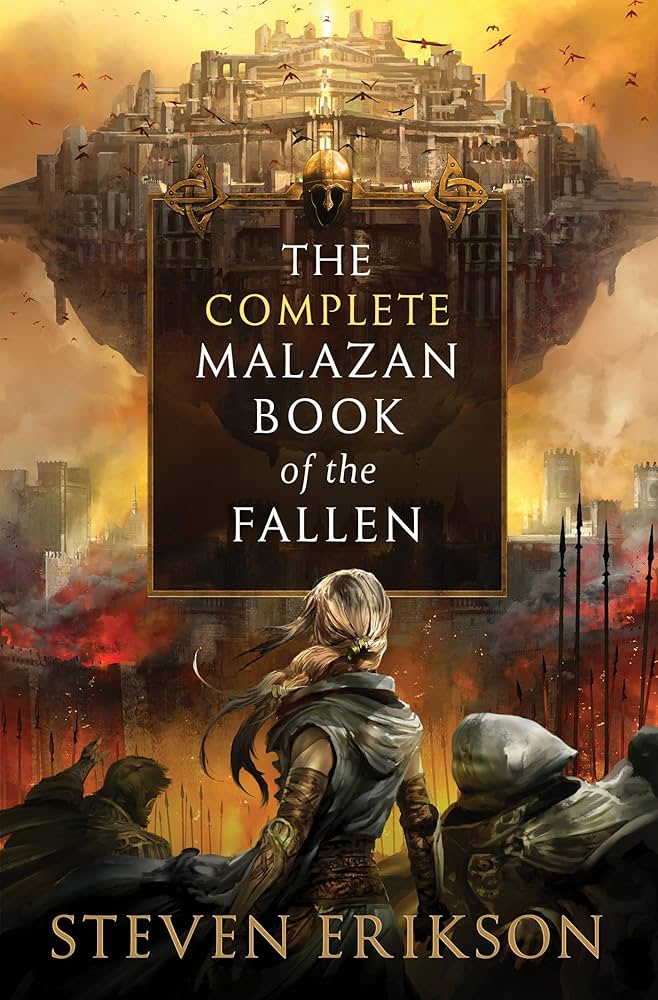
*The following contains minor spoilers for Malazan Book of the Fallen*
From a meager tabletop game to the peak of epic fantasy, Malazan Book of the Fallen is a tale written largely by Steven Erikson from 1999 to 2011. Spanning ten books and six novellas, it began with Gardens of the Moon and ended with The Crippled God. It’s a series whose scale rivals Tolkien’s, and its prose is praised by critics worldwide. It’s one of the best things I’ve ever read, and I’m not sure I can recommend it.
It’s a massive conflict that’s nearly impossible to pitch. If I had to summarize it in a sentence, it’s a tale about literally hundreds of characters and their struggles against a being called “The Crippled God.” But that doesn’t do it justice. You read about characters that have seemingly no relevance to the plot, while the points of view of heroes like Anamandor Rake and Adjunct Tavore — characters absolutely crucial to the plot and its stakes — elude you. And Steven Erickson doesn’t shy away from the harsh realities these characters face.
He doesn’t shy away from rape, brutal murders, and rug-pulls. Rug-pulls so harsh you’ll need to put the books down for a few days after reading them. After one of my favorite characters died in book two, I threw away the series and didn’t pick it up again for two years.
With all that being said, I’m not sure I’d recommend it to just anyone. I’d recommend it to someone who’s a massive fan of the fantasy genre and loves reading large books. I wouldn’t recommend it to my grandma.
Aside from the graphic content, the book can be a nightmare to get into. There’s a twenty-hour barrier to entry with Gardens of the Moon. Despite loving this series, I currently dislike its first entry. It’s everyone’s first impression of Steven Erickson, and it’s Erickson at his worst.
Gardens of the Moon was originally a movie script that Erickson adapted into a novel. Which — with his already confusing writing style — makes the series a nightmare to get into. Erickson is infamous for just dropping his readers into the story without catch up, the reader is sitting there and playing catch-up with the character from page one.
In Gardens of the Moon, there are also scenes in the book that just don’t make any sense. It can be a headache trying to read about these characters that a newbie author wrote. It can be hard to get invested in them—because again, Erickson just has a great grasp on what he was doing — and the writing around them is subpar.
I’ve not seen it discussed anywhere else, but I believe that Erickson wanted a “heroes on both sides” type of conflict when writing out the first book. However, he quickly discards this idea in favor of a very general “Malazan empire versus the forces of evil” narrative.
The second Malazan book was also written eight years after the first. Erickson is literally just a different person when writing subsequent entries in the series. He has grown as a person and writer by the time Deadhouse Gates comes around.
Another thing that makes Malazan a terror to get into is Erickson’s writing style. As mentioned before, he is notorious for writing densely and quickly. He has a background in writing short stories and archaeology, and it shows in his text. You have to be paying attention to what’s going on at any given moment, and what the characters are saying, if you want to have a chance at understanding what’s going on. Other authors will summarize what just happened or dumb things down for their readers. Not Erickson.
So, with all this context of why the series “sucks” and how graphic it is, why do I love it? It’s not because I’m some sicko who loves graphic content. (And there’s nothing wrong with that if you are, and if that’s an appeal for you.)
While you have villains committing unspeakable evil, there are also heroes who fight tooth and nail — with every fiber of their being — against this evil. Oftentimes, there is nothing that compels them other than wanting to be good people.
Coltaine of the Crow Clan fights against the traitorous Dog Slayers and attempts to escort innocent, hapless refugees over a hostile continent hundreds of miles long. Anamandor Rake lifts the despair and grief of an entire people onto his shoulders and attempts to give them purpose. He carries a sword — Dragnipur — with a burden so heavy that it cracks the stone of the earth when he sets it down. Trull Sengar defies his entire people, family and emperor, calling out evil and doing what’s right. Apsalar says goodbye to the love of her life to try to spare his soul. Spinnock Durav fights a battle he knows he can’t win, simply because his lord Rake asks it of him.
It’s just beautiful.
Those brief summaries don’t do Erickson justice. There are more points of view in Malazan than in any other series. He writes fiction that demands you to be smart and pay attention. He challenges you as a reader in every single way.
And if you happen to hate the point of view of the character you’re reading about, you never have to spend more than a few pages with them. In my opinion, this really helps mitigate any walls of text that might be considered “slogs.” While I love the Wheel of Time and Stormlight, this is definitely something both series can suffer from.
There are slogs in Malazan, too; they’re just not as heavy. There are plot lines and character arcs that don’t make as much sense until you have the benefit of hindsight and retrospect, but they’re still interesting to read.
And always, Steven Erickson is debating philosophy and morality in his text. That is what bogs it down the most, sometimes, in my opinion.
Picking up Malazan again was one of the best decisions I’ve ever made. As an adult who was slightly older and more mature, I was able to better understand it and follow the plot. In my own mind, it’s ascended to become my second-favorite book series after Brandon Sanderson’s The Stormlight Archives.
Steven Erikson has written many different books since finishing the main Malazan Book of the Fallen series. Since then, he’s written: the Kharkanas trilogy, Witness quartet, and the Bauchelain and Korbal Broach novellas, to name a few. Almost everything he writes takes place in the Malazan universe.
Erickson’s next novel is called Legacies for Betrayal, set to release around October 2026.