USUE welding students look to qualify for worlds
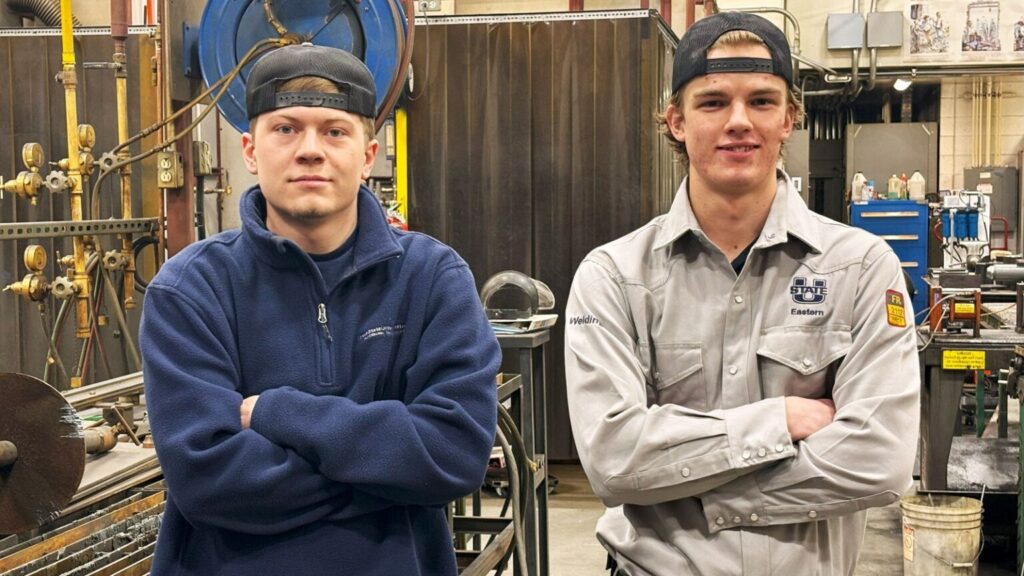
USU Eastern welding students, Ben Cornaby and Wyatt Hansen, are making preparations to participate in this year’s WorldSkills Competition. They are training and competing in the USA Weld Trials to see which sole USA welding contestant will move on to the WorldSkills Competition.
Cornaby, from Mapleton, Utah, is majoring in welding technology and Hansen, from Altamont, Utah, is majoring in an associates of applied science degree in welding. Both Cornaby and Hansen heard about the competition in high school when USU Eastern’s Chander Vincent was competing in 2017. Vincent won the national competition and placed fifth in the world competition in Abu Dhabi, United Arab Emirates.
Because of Vincent’s success, they decided to compete because they’d seen how much better they could get and the skills they could master.
Welding advisor Austin Welch said, “Cornaby and Hansen are two of the final three remaining USA Trials/WorldSkills candidates left in the country at this point.”
The three advisors, Jake Clement, Jeremiah Garcia and Welch help the students however and whenever they can.
“It takes full effort from all of the instructors and contestants to compete at this level. Honestly, what it comes down to is a lot of hard work, late nights, early mornings and fundraising,” Welch said. Helping these students is their job, but it’s why they are in this line of work. Watching their students succeed is an accomplishment in itself.
“I wanted to teach welding to continue the legacy of the program. I’ve seen the impact it’s had on over two decades worth of graduates, and it’s my great fortune to try and expand on that and impact my own students,” he continued.
What these advisors strive for isn’t perfection, yet on this level of competition near perfectness is somewhat needed. Not only does working on Cornaby and Hansen’s skills make them tough competition, but gives them better opportunities for the career they want.
Cornaby said, “Preparing for the WorldSkills Competition for me simply involves putting in the time.” They train at least 60 hours a week minimum and need to be able to replicate any weld at a given time to receive points when it matters most. “I hope to weld something I’m quicker at because it feels good to be ahead of the clock while competing,” he continues. There is a lot of pressure when competing against a clock and other contestants for what these students are making their life’s work.
Hansen said, “I’ve spent the past eight months training from 7:30/8 in the morning until 11 to 12 at night, six to seven days a week.”
The welding skills both Cornaby and Hansen are working to perfect matter throughout the world. Becoming a world-class welder could essentially take them anywhere they want.